Sections in this page

Your Safety, Our Mission

rideRTC connects tens of thousands of residents in our community to jobs, school, medical appointments, and more, while transporting millions of visitors up and down the Las Vegas Strip. Last year, alone, we made more than 55 million passenger trips.

Making these connections safe remains our top priority.  As an agency, our goal is to be transparent about our security operations by providing information on the steps that are being taken to better protect our customers and operators.

As public safety concerns have increased in recent years, we have engaged with riders, drivers, security officers, and our community to develop a comprehensive, multi-prong approach to making transit safer in Southern Nevada. This ongoing approach to safety includes a focus on continuous security data analysis, investment in security personnel and technology, strategic bus stop placement and lighting, education campaigns, and partnerships.
A blue shield with a gold outline and a star at the top contains the words EVERYDAY SAFER in bold white letters and the RTC logo with a rising sun at the bottom.

What We’re Doing

Step on board with confidence! Our buses are equipped with state-of-the-art safety features and adhere to the highest industry standards. From well-maintained vehicles and well-lit bus stops to vigilant and trained drivers and security staff, we leave no stone unturned in ensuring your safety.

Senate Bill 290, passed during the 2025 Nevada legislative session, amends state law to grant RTC security officers the authority to remove disruptive or unlawful individuals from RTC transit vehicles or property. While the bill, which took effect on October 1, 2025, does not grant arrest powers, it strengthens security measures, enhances safety, and reduces service interruptions by allowing officers to act decisively.

The proposal originated in 2024 after RTC convened a Transit Security Discussion Group with representatives from labor, law enforcement, the District Attorney’s office, civil rights organizations, community groups, and transit riders, who identified the need for clearer authority to address disruptive behavior.

Refresher training is currently underway with officers who have been on the RTC account for at least one year. During the course, special emphasis will be given to SB290.

RTC’s security operations are conducted by its contractor Inter-Con Security, which is responsible for carrying out the day-to-day tasks that ensure the safety and protection of customers, contractors, vendors, and employees, as well as RTC property and equipment.

  • RTC’s agreement with Inter-Con Security, which began on July 1, 2024. Under the new contract, the number of security officers grew from 247 to 300, and all field officers are now armed.
  • To enhance visibility on buses and at transit terminals, security officers now wear high-visibility uniforms to help deter incidents. They are also required to remain standing while on the bus, reinforcing both a professional appearance and a commanding presence.
  • To improve response times to drivers and incidents, the number of security patrol areas was doubled from six to twelve, reducing the size of each quadrant.

As a result, there has been a 99.89% reduction in full eight-hour vacant positions across the system.

We understand that technology is a key component to help monitor and respond to incidents in an efficient and timely manner. We are continually exploring new and emerging technology to enhance safety.

Equipment Enhancements
To assist with oversight and accountability, the new security contract added cellular technology that offers real-time incident reporting and a security officer GPS tracking system.  Also, security officers now wear bulletproof vests and high-resolution Axon body cameras that allow GPS tracking and live look-in to assist with incident investigations.

On-Board Cameras and Video Feeds
As of January 2024, we completed a camera upgrade project on all fixed-route buses, giving the contractor, RTC staff, and local law enforcement access to live camera feeds. The improved technology has allowed for a strengthened partnership and better collaboration between RTC and the LVMPD Fusion Center, which is a counterterrorism center in Southern Nevada that provides an information-sharing partnership among 17 agencies.

Nano Panic Buttons 
In 2024, RTC became the first transit agency in the United States to launch the Nano Panic Button on all buses. This GPS-based device allows operators to request immediate assistance from security both on and off the bus, simultaneously alerting dispatch, the operations center, rovers, area commanders, and RTC staff for a faster response. In Fiscal Year 2025, the panic buttons were activated 46 times.

Command Center
In 2023, we added staffing to our 24/7 command center and added features like GPS tracking and live incident reporting to aid in faster response times.

Weapons Detection System
RTC now uses ZeroEyes AI gun detection technology at eight facilities, supported by 270 video streams that provide comprehensive coverage. Launched as a pilot in 2024 at four facilities, the system uses artificial intelligence to detect when someone is brandishing a firearm in a threatening manner. Integrated with existing security cameras, ZeroEyes can identify visible firearms and alert law enforcement and transit security within seconds, reducing response times and helping prevent incidents before they escalate.

Your safety doesn’t stop when you step off the bus. Our commitment extends to creating safe havens at every bus stop. Well-lit, monitored, and strategically located, our bus stops are designed with your security in mind. We understand that safety isn’t just about the ride; it’s about the entire transit experience.

Shelter Lighting
Shelters with additional lighting to increase nighttime safety have been installed. Since 2019, we have installed more than 2,000 standalone solar-powered lights to increase safety for those waiting for their bus.

Shelter Placement
We have and will continue to push transit shelters back from the curb whenever we have the space and property rights. Since 2011 the RTC has spent more than 18 million to improve pedestrian safety. Additionally, we feel that the ability to have shelters at bus stops where we are able is important to help customers feel safe. Out of more than 3,700 active bus stops, 1,741 stops have shelters of some kind. Over the next two years, the RTC is scheduled to install 125 additional slimline shelters and 150 general shelters.

New Shelter Design
The RTC is currently finalizing the design of our dual-directional shelters to increase capacity and shade at a given stop. These shelters are grant-funded and anticipate procuring 120 once the design is complete.

Community Approach

Beyond the buses and bus stops, our commitment to safety extends into the heart of the communities we serve. Through educational initiatives, community outreach, and collaborative marketing efforts, we aim to foster a culture of safety that permeates every neighborhood we touch. Your safety is not just a priority for us – it’s a shared responsibility we take to heart.

We launched Every Day Safer to let our community and transit riders know about the safety measures we have in place, our ongoing prioritization and expansion of safety programs, and how best to report incidents.

We invite our community to be part of the solution by reporting anything and everything they deem suspicious, and we want potential criminals and perpetrators to know that they will be seen and brought to justice. We’ve made the process easy by incorporating the Transit Watch feature into the rideRTC app. As part of this new campaign, we will continue to reinforce the elements included in our transit Code of Conduct.

Investment in Our Future

Since 2015, we have invested more than $33 million on security services and safety upgrades throughout our transit system. We understand our work is far from complete, so we are continually working on new ways to improve safety for our customers.

Improving Operator Safety
Additional de-escalation training is being planned by the fixed route services contractor for drivers and security officers. Dispatch training is also on the horizon for both the fixed route services contractor and the security contractor. Research is ongoing by the RTC to evaluate whether safer enclosures for bus operators are currently available.
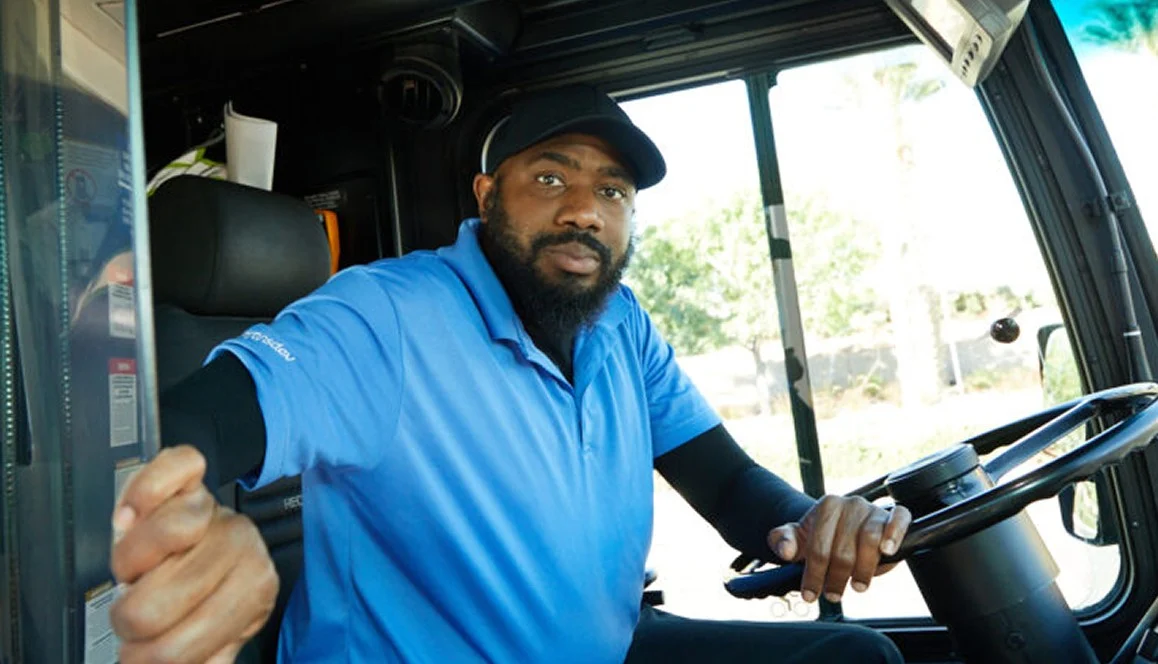
A man wearing a blue polo shirt and black cap sits in the drivers seat of a bus, holding the steering wheel with one hand and the bus door handle with the other, looking toward the camera.

Partners in Safety

Our transit system is part of our larger Southern Nevada community and as such, it faces the same issues that our entire community faces including homelessness and mental health.  We continue to partner with our local agencies and law enforcement to supplement our security officers’ response when necessary and to provide support for victims of crimes. As a result, RTC has been able to develop new relationships with social service providers to better serve some of the system’s most vulnerable customers.


Safety by the Numbers

In fiscal year 2025, we carried more than 55 million passengers, a 6 percent increase in ridership over the previous year. During the same period, reported incidents rose from 125 to 218. Incidents fluctuate, and with the additional 3.5 million trips in FY 25, we anticipated an increase in assaults.

We believe that one incident is one too many and we remain committed to evaluating our programs, processes and investments and working with our transit community to make every day safer.

Passenger-on-passenger assaults by fiscal year:
RTC defines “assault” as the unlawful use of physical force or spitting upon the person of another.

  • FY 2019: 126 assaults (1 to every 511,159 passengers)
  • FY 2020: 179 assaults (1 to every 315,033 passengers)
  • FY 2021: 153 assaults (1 to every 228,791 passengers)
  • FY 2022: 195 assaults (1 to every 210,016 passengers)
  • FY 2023: 166 assaults (1 to every 298,741 passengers)
  • FY 2024: 99 assaults (1 to every 527,310 passengers)
  • FY 2025: 190 assaults (1 to every 293,433 passengers)

Passenger-on-Operator assaults by fiscal year:
RTC defines “assault” as the unlawful use of physical force or spitting upon the person of another.

  • FY 2019: 36 assaults (1 to every 1,789,056 passengers)
  • FY 2020: 42 assaults (1 to every 1,342,641 passengers)
  • FY 2021: 38 assaults (1 to every 921,185 passengers)
  • FY 2022: 32 assaults (1 to every 1,279,786 passengers)
  • FY 2023: 35 assaults (1 to every 1,416,885 passengers)
  • FY 2024: 26 assaults (1 to every 2,007,834 passengers)
  • FY 2025: 28 assaults (1 to every 1,991,156 passengers)